Back when I was still using Stephanie Rose, I wrote this article in 2004 and it was published in Buzzine Magazine. Since then, the methods and statistics may have changed, but the back story remains the same. Here is my article:
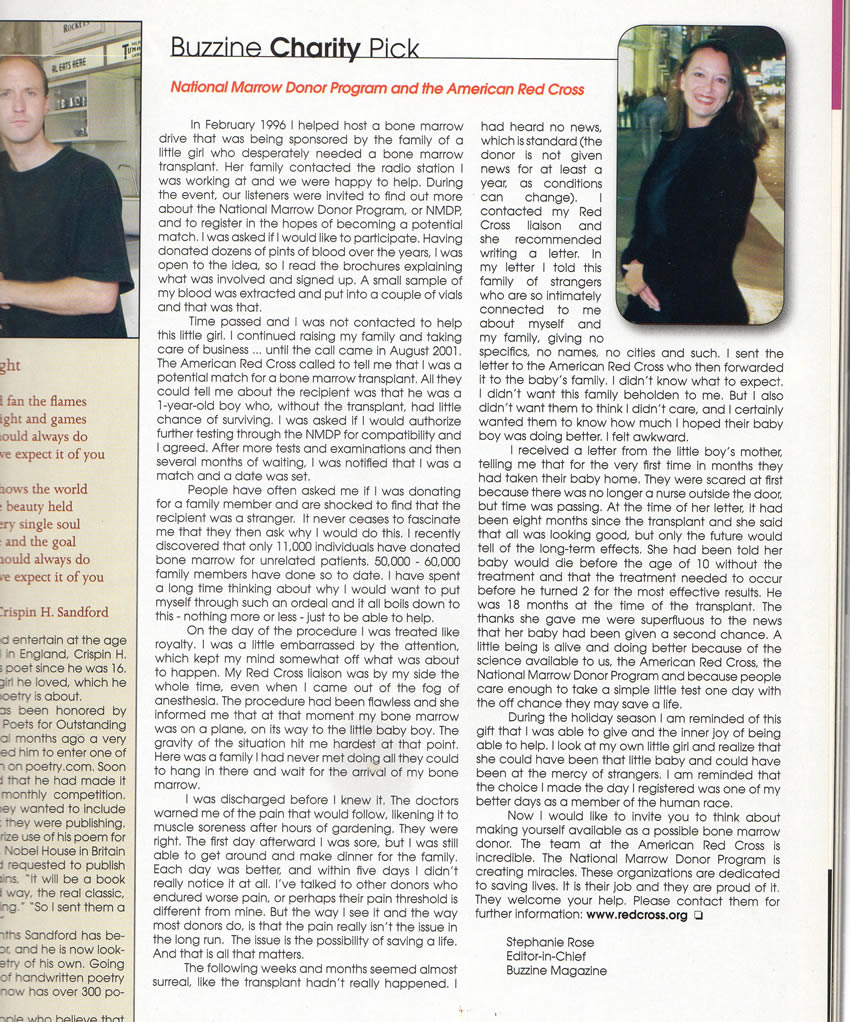
Original Bone Marrow Article
In February 1996, I helped host a bone marrow drive that was being sponsored by the family of a little girl who desperately needed a bone marrow transplant. Her family contacted the radio station I was working at and we were happy to help. During the event, our listeners were invited to find out more about the National Marrow Donor Program, or NMDP, and to register in the hopes of becoming a potential match. I was asked if I would like to participate. Having donated dozens of pints of blood over the years, I was open to the idea so I read the brochures explaining what was involved and signed up. A small sample of my blood was extracted and put into a couple of vials and that was that.
Time passed and I was not contacted to help this little girl. I continued raising my family and taking care of business that is until the call came in August 2001. The American Red Cross called to tell me that I was a potential match for a bone marrow transplant. All they could tell me about the recipient was that he was a 1-year-old boy who, without the transplant, had little chance of surviving. I was asked if I would authorize further testing through the NMDP for compatibility and I agreed. After more tests and examinations and then several months of waiting, I was notified that I was a match and a date was set.
People have often asked me if I was donating for a family member and are shocked to find that the recipient was a stranger. It never ceases to fascinate me that they then ask why I would do this. I recently discovered that only 11,000 individuals have donated bone marrow for unrelated patients. 50,000 – 60,000 family members have done so to date. I have spent a long time thinking about why I would want to put myself through such an ordeal and it all boils down to this – nothing more or less – just to be able to help.
On the day of the procedure I was treated like royalty. I was a little embarrassed by the attention, which kept my mind somewhat off what was about to happen. My Red Cross liaison was by my side the whole time, even when I came out of the fog of anesthesia. The procedure had been flawless and she informed me that at that moment my bone marrow was on a plane, on its way to the little baby boy.
The gravity of the situation hit me hardest at that point. Here was a family I had never met doing all they could to hang in there and wait for the arrival of my bone marrow.
I was discharged before I knew it. The doctors warned me of the pain that would follow, likening it to muscle soreness after hours of gardening. They were right. The first day afterward I was sore, but I was still able to get around and make dinner for the family. Each day was better, and within five days I didn’t really notice it all. I’ve talked to other donors who endured worse pain, or perhaps their pain threshold is different from mine. But the way I see it and the way most donors do, is that the pain really isn’t the issue in the long run. The issue is the possibility of saving a life. That is all that matters.
The following weeks and months seemed almost surreal, like the transplant hadn’t really happened. I had heard no news, which is standard (the donor is not given news for at least a year, as conditions can change). I contacted my Red Cross liaison and she recommended writing a letter. In my letter I told this family of strangers who are so intimately connected to me about myself and my family, giving no specifics, no names, no cities and such. I sent the letter to the American Red Cross who then forwards it to the baby’s family. I didn’t know what to expect. I didn’t want this family beholden to me. But I also didn’t want them to think I didn’t care, and I certainly wanted them to know how much I hoped their baby boy was doing better. I felt awkward.
I received a letter from the little boy’s mother telling me that for the very first time in months they had taken their baby home. They were scared at first because there was no longer a nurse outside the door, but time was passing. At the time of her letter, it had been eight months since the transplant and she said that all was looking good, but only the future would tell of the long-term effects. She had been told her baby would die before the age of 10 without the treatment and that the treatment needed to occur before he turned two for the most effective results. He was 18 months at the time of the transplant. The thanks she gave me were superfluous to the news that her baby had been given a second chance. A little being is alive and doing better because of the science available to us, the American Red Cross, the National Marrow Donor Program and because people care enough to take a simple little test one day with the off chance they may save a life.
During the holiday season I am reminded of this gift that I was able to give and the inner joy of being able to help. I look at my own little girl and realize that she could have been that little baby and could have been at the mercy of strangers. I am reminded that the choice I made the day I registered was one of my better days as a member of the human race.
Now I would like to invite you to think about making yourself available as a possible bone marrow donor. The team at the American Red Cross is incredible. The National Marrow Donor Program is creating miracles. These organizations are dedicated to saving lives. It is their job and they are proud of it. They welcome your help. Please contact them for further information
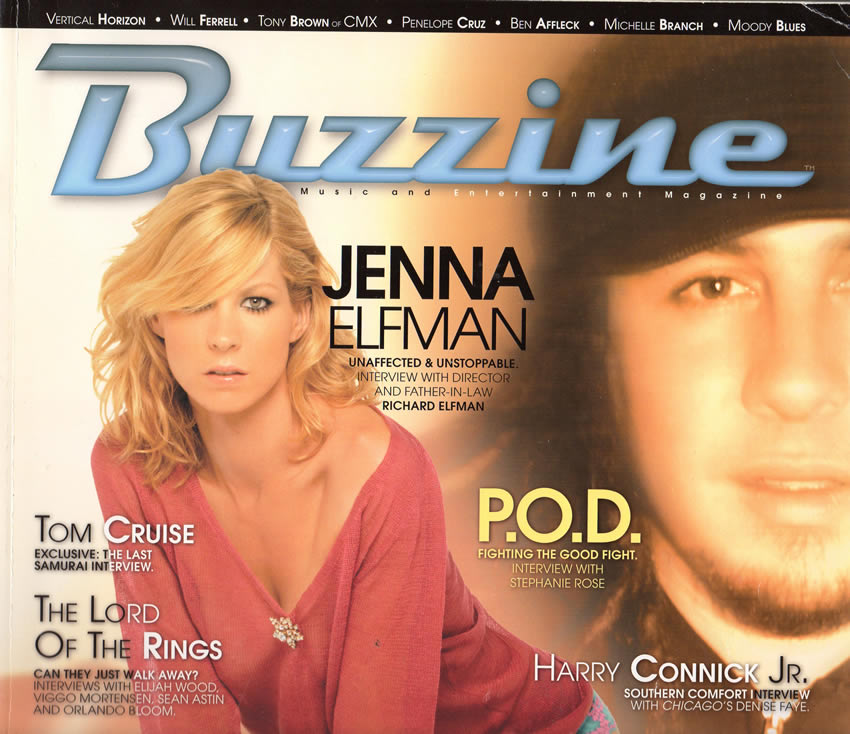
Issue of Buzzine with Bone Marrow article in it.
Stephanie Rose
Editor-in-Chief
Buzzine Magazine